

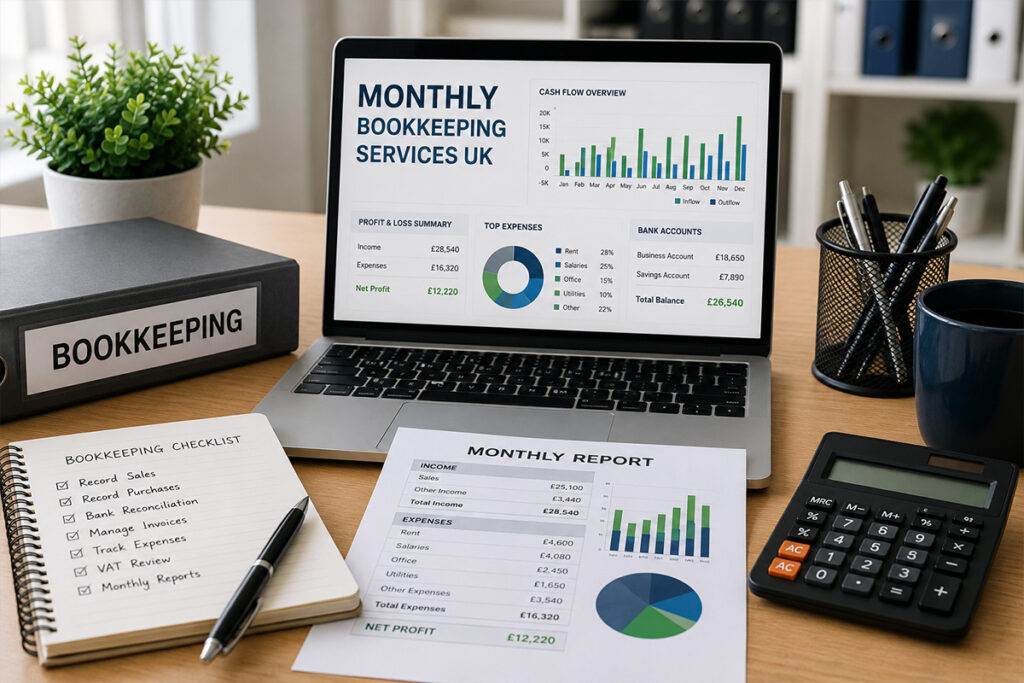
Monthly Bookkeeping Services UK provide businesses with a structured way to keep their financial records accurate, organised, and up to date throughout the year. Instead of allowing transactions, invoices, expenses, and bank records to build up until the end of the financial year, businesses can review and maintain their accounts every month.
For many UK businesses, bookkeeping is an essential but time-consuming part of financial management. As transaction volumes increase, keeping track of sales, purchases, expenses, payments, invoices, and bank transactions can become difficult to manage alongside everyday business operations.
Professional monthly bookkeeping support can help businesses maintain better financial records while giving business owners a clearer view of their financial position.
This guide explains what monthly bookkeeping involves, why it is important, what services are usually included, and how businesses can decide whether monthly bookkeeping support is right for them.
What Are Monthly Bookkeeping Services UK?
Monthly Bookkeeping Services UK involve recording, organising, reviewing, and reconciling a business’s financial transactions on a monthly basis.
Rather than updating records only when accounts or tax deadlines approach, monthly bookkeeping creates a regular financial management process.
Depending on the business and service provider, monthly bookkeeping may include:
- Recording sales and purchases
- Recording business expenses
- Bank reconciliation
- Credit card reconciliation
- Sales invoice recording
- Supplier invoice recording
- Accounts receivable tracking
- Accounts payable tracking
- VAT transaction review
- Expense categorisation
- Financial reports
- Month-end bookkeeping review
The exact service can be adapted according to the size, industry, and accounting requirements of the business.
Why Is Monthly Bookkeeping Important?
Financial records are most useful when they are accurate and up to date.
If bookkeeping is delayed for several months, business owners may not have a clear picture of current revenue, expenses, outstanding invoices, or cash flow. This can make financial decision-making more difficult.
With Monthly Bookkeeping Services UK, businesses can maintain their records regularly and review financial information throughout the year.
Monthly bookkeeping can help businesses:
- Understand current financial performance
- Monitor income and expenses
- Track outstanding customer payments
- Keep supplier records organised
- Identify unusual transactions
- Prepare for VAT reporting
- Support year-end accounting
- Make better financial decisions
Regular bookkeeping is therefore not simply an administrative task. It can become an important part of financial planning.
What Is Included in Monthly Bookkeeping Services?
The services included can vary between providers, but a typical monthly bookkeeping package may cover several important areas.
1. Recording Financial Transactions
The first step is maintaining a record of business transactions.
This can include sales, purchases, expenses, payments received, supplier payments, bank transactions, and other financial activity.
Transactions should be categorised appropriately so that financial reports provide a useful representation of the business.
2. Bank Reconciliation
Bank reconciliation involves comparing transactions recorded in the accounting system with the business bank statement.
This helps identify:
- Missing transactions
- Duplicate entries
- Incorrect amounts
- Unrecorded payments
- Timing differences
Regular reconciliation can help businesses identify discrepancies sooner rather than discovering them months later.
3. Sales and Purchase Ledger
Monthly bookkeeping can include maintaining records of customer invoices and supplier bills.
A well-maintained sales ledger helps businesses understand which customers have paid and which invoices remain outstanding.
Similarly, a purchase ledger helps businesses monitor amounts owed to suppliers and upcoming payments.
4. Expense Management
Businesses incur many different types of expenses, from office costs and software subscriptions to travel and professional services.
Monthly bookkeeping involves recording and categorising these expenses appropriately, helping business owners understand where money is being spent.
5. Accounts Receivable Tracking
Accounts receivable refers to money owed to the business by customers.
Regular bookkeeping can help businesses monitor outstanding invoices and identify overdue payments.
This information can support better cash flow management and help businesses decide when follow-up action may be required.
6. Accounts Payable Tracking
Accounts payable refers to money the business owes to suppliers and other parties.
Maintaining accurate supplier records can help businesses understand upcoming financial commitments and avoid missing important payments.
7. VAT Record Support
For VAT-registered businesses, accurate bookkeeping provides the financial information required to support VAT reporting.
VAT transactions should be recorded appropriately throughout the accounting period rather than reconstructed shortly before a VAT return deadline.
Businesses should ensure that their VAT processes meet the requirements applicable to their circumstances.
8. Monthly Financial Reports
Depending on the service, businesses may receive regular financial reports.
These can provide information about:
- Sales
- Expenses
- Profit and loss
- Outstanding invoices
- Supplier balances
- Cash position
Monthly reporting can give management a clearer understanding of how the business is performing.
10 Benefits of Monthly Bookkeeping Services UK
1. Better Financial Visibility
One of the biggest advantages of monthly bookkeeping is having more current financial information.
Instead of relying on old figures, business owners can review recent revenue, expenses, and cash flow.
2. Improved Cash Flow Management
Cash flow can have a major impact on business stability.
Monthly bookkeeping helps businesses identify outstanding customer invoices, upcoming supplier payments, and changes in income and expenses.
This can make cash flow planning easier.
3. Saves Business Time
Bookkeeping requires regular attention.
Business owners who try to manage all bookkeeping themselves may spend valuable time entering transactions, checking invoices, and reconciling accounts.
Outsourcing monthly bookkeeping can reduce this administrative workload.
4. Easier VAT Preparation
Businesses that are VAT registered need to maintain appropriate VAT records.
When bookkeeping is completed regularly, the financial information required for VAT reporting is easier to review and organise.
5. Fewer Last-Minute Problems
Leaving bookkeeping until the end of the year can create unnecessary pressure.
Monthly processing spreads the workload across the year and provides opportunities to identify and correct discrepancies earlier.
6. Better Business Decisions
Financial information is more useful when it is available regularly.
Business owners can use monthly reports to assess sales performance, operating costs, profitability, and cash flow before making important decisions.
7. Easier Year-End Accounting
When transactions have already been recorded and reconciled throughout the year, year-end accounting can become more organised.
This can make it easier for accountants to review records and prepare the required accounts.
8. Improved Invoice Tracking
Regular bookkeeping provides better visibility of outstanding customer invoices.
Businesses can identify overdue amounts and take appropriate steps to manage their receivables.
9. Scalable Support
A business’s bookkeeping requirements can change as it grows.
A small business may have relatively few monthly transactions, while a growing company may need more detailed bookkeeping, reconciliations, reporting, and accounts support.
Monthly services can often be adjusted as requirements change.
10. More Organised Financial Records
Consistent bookkeeping creates a structured financial history for the business.
Well-organised records can be useful for management reporting, accounting, tax preparation, financial reviews, and future planning.
Who Can Benefit From Monthly Bookkeeping Services UK?
Monthly bookkeeping can be useful for businesses across many industries.
These may include:
- Small businesses
- Startups
- Limited companies
- SMEs
- Sole traders
- E-commerce businesses
- Retail companies
- Construction businesses
- Hospitality businesses
- Professional service firms
- Technology companies
- Property businesses
The size of the business is not the only factor. Transaction volume, financial complexity, internal resources, and reporting requirements can also determine whether monthly bookkeeping is beneficial.
Monthly vs Annual Bookkeeping
Some businesses may be tempted to update their accounts only when annual accounts or tax deadlines approach.
While this may appear simpler, delayed bookkeeping can create several challenges.
With annual or irregular bookkeeping:
- Financial information may be outdated
- Cash flow problems can be harder to identify
- Outstanding invoices may be overlooked
- Errors may remain unnoticed for longer
- Year-end preparation can become stressful
Monthly bookkeeping creates a more consistent process.
For growing businesses, having regular financial information can be particularly useful because management does not have to wait until the end of the financial year to understand business performance.
In-House vs Outsourced Monthly Bookkeeping
Businesses can choose to manage bookkeeping internally or outsource it to an external provider.
An in-house bookkeeper provides direct access to someone within the organisation. However, hiring an employee also involves salary costs, recruitment, training, software, and other employment-related expenses.
Outsourcing can provide access to experienced bookkeeping professionals without requiring a business to create a full-time bookkeeping position.
The right approach depends on factors such as:
- Number of monthly transactions
- Business size
- Budget
- Internal accounting knowledge
- Accounting software
- Reporting requirements
- Future growth plans
Some businesses may also use a combination of internal and outsourced support.
How Technology Supports Monthly Bookkeeping
Accounting technology has changed the way businesses maintain financial records.
Cloud accounting platforms can help businesses manage transactions, invoices, expenses, bank feeds, and financial reports from one system.
Popular accounting platforms used by UK businesses include Xero, QuickBooks, and Sage.
Automation can reduce repetitive data entry, but businesses still need appropriate review and oversight. Incorrectly categorised transactions or incomplete records can affect the accuracy of financial reports even when accounting software is being used.
This is why technology and professional bookkeeping expertise often work best together.
How to Choose Monthly Bookkeeping Services UK
Choosing a bookkeeping provider should involve more than looking at the lowest price.
Businesses should consider:
Experience
Look for experience working with UK businesses and, where relevant, businesses in the same industry.
Accounting Software Knowledge
Check whether the provider works with the accounting platform used by your business.
Service Scope
Understand exactly what is included in the monthly package.
For example, does it include bank reconciliation, invoice processing, VAT support, and monthly reports?
Communication
A clear communication process is important when financial information needs clarification or transactions require additional documentation.
Data Security
Bookkeeping involves sensitive financial and business information. Businesses should understand how their provider handles data access and security.
Scalability
Choose a provider that can accommodate changing requirements as the business grows.
Common Monthly Bookkeeping Mistakes to Avoid
Even businesses that maintain their accounts regularly can encounter bookkeeping problems.
Common mistakes include:
- Failing to reconcile bank accounts
- Mixing personal and business expenses
- Incorrectly categorising transactions
- Forgetting to record small expenses
- Losing invoices or receipts
- Recording duplicate transactions
- Not following up on overdue invoices
- Delaying bookkeeping reviews
- Using outdated financial information
A consistent monthly review process can help identify many of these issues.
Monthly Bookkeeping Checklist
Businesses can use a simple monthly checklist to keep their financial records organised:
- Review sales transactions
- Record purchase invoices
- Record business expenses
- Reconcile bank accounts
- Reconcile credit cards
- Review accounts receivable
- Review accounts payable
- Check outstanding invoices
- Review VAT-related transactions
- Check unusual or duplicate transactions
- Review monthly profit and loss
- Prepare management reports where required
This process can be adapted to suit the business’s individual needs.
Final Thoughts
Keeping financial records updated should be an ongoing business activity rather than a task left until the end of the financial year. Regular bookkeeping provides business owners with clearer financial information and can make accounting administration more manageable.
Monthly Bookkeeping Services UK can help businesses maintain accurate records, monitor cash flow, track invoices, support VAT processes, and prepare for year-end accounting. For growing companies, regular bookkeeping can also provide useful information for making informed financial and operational decisions.
The right bookkeeping approach will depend on the size of the business, transaction volume, accounting requirements, internal resources, and future plans. Whether bookkeeping is managed internally or outsourced, consistency and accuracy should remain the priority.
Know More About Finex Accounting
If your business needs professional Monthly Bookkeeping Services UK, Finex Accounting provides outsourced bookkeeping and accounting support for UK businesses and accounting firms.
Explore the service to learn more about professional bookkeeping support.
Know More: Stay updated with the latest accounting insights, outsourcing tips, and industry trends by following Finex Accounting on LinkedIn and Instagram. Connect with us for practical advice, business updates, and expert financial guidance.