
VAT Registration Services UK can help businesses understand and manage the process of registering for Value Added Tax (VAT) with HM Revenue & Customs (HMRC). VAT registration is an important step for businesses whose taxable turnover reaches the compulsory registration threshold, while some businesses below the threshold may choose to register voluntarily.
For UK businesses, VAT registration involves more than simply obtaining a VAT number. Businesses need to understand their taxable turnover, registration requirements, effective registration date, VAT records, invoicing responsibilities and ongoing VAT compliance.
As the rules can vary depending on the type of business and its activities, understanding the process before registering can help businesses avoid unnecessary errors.
This guide explains VAT Registration Services UK, when a business may need to register, voluntary registration, the registration process, what happens after registration, common mistakes and how professional support can help.
What Is VAT Registration?
VAT registration is the process through which a business registers with HMRC to account for VAT on its taxable supplies.
Once registered, a business generally needs to charge VAT at the appropriate rate on relevant taxable sales, keep VAT records, account for VAT on applicable purchases and submit VAT Returns to HMRC.
VAT registration can apply to different types of businesses, including:
- Limited companies
- Sole traders
- Partnerships
- Other business structures
- UK businesses supplying taxable goods or services
- Certain overseas businesses supplying the UK
The exact rules depend on the business’s activities and circumstances.
When Does a UK Business Need to Register for VAT?
One of the most important things businesses need to monitor is their taxable turnover.
As of 2026, the UK VAT registration threshold is £90,000. A business generally must register if its taxable turnover for the previous 12 months exceeds £90,000, or if it expects its taxable turnover to exceed £90,000 in the next 30 days.
Taxable turnover is not necessarily the same as total business income.
HMRC explains taxable turnover as the total value of supplies that are not VAT-exempt or outside the scope of VAT. This can include zero-rated and reduced-rated supplies.
The £90,000 Threshold
Businesses should regularly monitor their rolling taxable turnover rather than waiting until the end of the financial year.
For example, a business may gradually increase its sales over several months and eventually cross the £90,000 threshold.
Once the threshold is exceeded, the business needs to follow HMRC’s registration rules and deadlines.
What Happens If You Expect to Exceed the Threshold?
Businesses do not necessarily have to wait until they have already exceeded £90,000.
If a business expects its taxable turnover to exceed £90,000 in the next 30 days, it may need to register for VAT.
HMRC provides specific rules regarding the effective date of registration when a business expects to exceed the threshold in the next 30 days.
This is why businesses should monitor sales forecasts as well as historical turnover.
Yes.
A business whose taxable turnover is below the compulsory registration threshold can choose voluntary VAT registration, provided it meets the relevant conditions.
HMRC confirms that businesses can voluntarily register when their taxable turnover is below £90,000.
Voluntary registration can sometimes be useful, but it is not automatically the right decision for every business.
Businesses should consider factors such as:
- Customer type
- VAT on business purchases
- Pricing
- Administrative workload
- Cash flow
- Industry
- Whether customers can recover VAT
- Future business growth
Why Might a Business Register Voluntarily?
There can be several reasons why a business might consider voluntary registration.
Recovering Eligible Input VAT
A VAT-registered business may be able to recover eligible VAT incurred on business purchases, subject to the relevant rules.
Business Growth
A business expecting to grow beyond the registration threshold may choose to prepare for VAT earlier.
Working With VAT-Registered Customers
Some business-to-business customers may prefer suppliers that are VAT registered, although this depends on the nature of the relationship.
Professional Business Structure
VAT registration can sometimes be appropriate for businesses that are developing a larger commercial operation.
However, voluntary registration also creates ongoing VAT responsibilities, so businesses should consider the wider implications before registering.
What Are VAT Registration Services UK?
VAT Registration Services UK generally involve professional support with the VAT registration process and related administrative requirements.
Depending on the provider, support may include:
- Reviewing VAT registration requirements
- Assessing taxable turnover
- Understanding the appropriate registration route
- Preparing registration information
- Supporting the HMRC application
- Reviewing the effective date of registration
- Helping organise VAT records
- Supporting VAT invoicing processes
- Providing ongoing VAT compliance support
Professional support can be particularly useful when a business is approaching the threshold and is unsure whether it needs to register.
How Does VAT Registration Work?
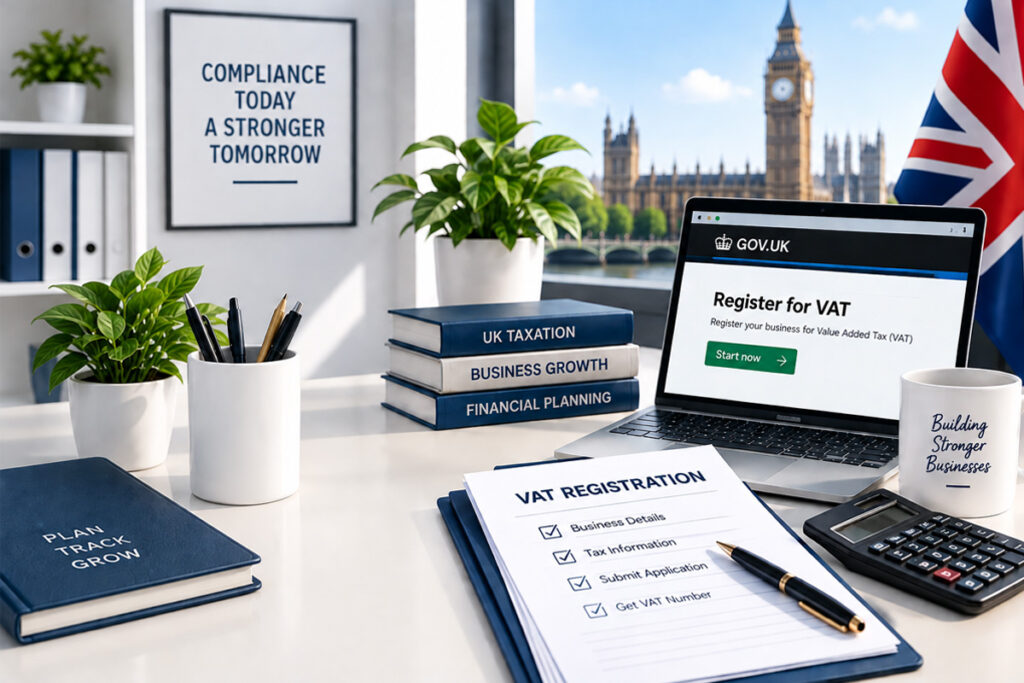
The registration process requires the business to provide information to HMRC.
According to HMRC, businesses registering online may need information including:
- Bank account details
- Unique Taxpayer Reference (UTR), if applicable
- Annual turnover
- Estimated taxable turnover for the next 12 months
- Relevant tax information
- Business details
HMRC provides an online VAT registration service, although some circumstances require alternative registration procedures.
What Happens After VAT Registration?
VAT registration creates ongoing responsibilities.
A registered business generally needs to:
Charge VAT
VAT must be charged at the correct rate on relevant taxable goods and services.
Keep VAT Records
Businesses need to maintain appropriate records of VAT charged and VAT paid.
Submit VAT Returns
VAT-registered businesses normally need to submit VAT Returns to HMRC, commonly on a quarterly basis, although the filing frequency can depend on the accounting scheme and circumstances.
Pay VAT Due
Where the VAT charged exceeds the recoverable VAT paid on eligible business purchases, the difference may need to be paid to HMRC.
If eligible input VAT exceeds output VAT, the business may generally be entitled to a repayment.
Understanding VAT Rates
The VAT rate applicable to a transaction depends on the goods or services being supplied.
For 2026–27, the standard UK VAT rate is 20%, the reduced rate is 5%, and the zero rate is 0%. Certain supplies are exempt from VAT rather than zero-rated.
Businesses should not assume that every sale is subject to the standard 20% rate.
The correct VAT treatment depends on the nature of the goods or services and the applicable VAT rules.
1. Better Understanding of Registration Requirements
VAT rules can be difficult to interpret, particularly when a business has different types of supplies.
Professional support can help businesses understand the relevant registration requirements.
2. Reduced Risk of Late Registration
Businesses have specific deadlines once they become liable to register.
Getting professional support can help businesses monitor their obligations and avoid unnecessary delays.
3. Accurate Turnover Assessment
Calculating taxable turnover correctly is an important part of determining whether registration is required.
4. Support With HMRC Information
VAT registration requires business and financial information.
Professional support can help businesses prepare the required information before submitting an application.
5. Better VAT Record Organisation
Once registered, businesses need to maintain appropriate VAT records.
Professional support can help establish organised processes.
6. Easier Transition to VAT
Moving from a non-VAT-registered business to a VAT-registered business can involve changes to invoices, pricing, accounting systems and financial processes.
Professional guidance can make the transition more structured.
7. Improved Invoice Accuracy
VAT invoices need to contain appropriate information.
A structured VAT process can help reduce invoicing errors.
8. Better Ongoing Compliance
VAT registration is only the beginning.
Businesses need to continue meeting their VAT reporting and record-keeping obligations.
9. More Time for Business Owners
Managing VAT administration can take time.
Professional support can allow business owners to focus more on customers, operations and growth.
10. Support as the Business Grows
VAT requirements can become more complex as sales volumes, customers and business activities increase.
Ongoing accounting support can help businesses manage these changes.
Common VAT Registration Mistakes
Waiting Until the Last Minute
Businesses should monitor taxable turnover regularly rather than waiting until they suddenly cross the threshold.
Confusing Total Turnover With Taxable Turnover
Not every type of income is necessarily treated in the same way for VAT purposes.
Understanding which supplies count towards the threshold is important.
Assuming Everything Is Charged at 20%
Different VAT treatments can apply depending on the goods or services.
Using the Wrong Effective Registration Date
The effective date depends on the circumstances in which the registration requirement arises.
Businesses should take care when determining the correct date.
Ignoring VAT After Registration
Registering for VAT does not complete the process. Businesses then have ongoing record-keeping, invoicing and VAT Return responsibilities.
VAT Registration for Overseas Businesses
VAT rules can also apply to businesses based outside the UK.
HMRC states that an overseas business may need to register regardless of turnover where the relevant conditions apply, including where the business is based outside the UK and supplies goods or services to the UK or expects to do so within the next 30 days.
This area can be more complex, particularly where the business has no UK establishment.
Businesses in this situation should carefully review HMRC guidance or seek professional advice.
VAT Registration and Accounting Software
Accounting software can make VAT administration easier once a business is registered.
Cloud accounting platforms can help businesses:
- Record sales
- Record purchases
- Track VAT
- Reconcile bank transactions
- Maintain digital records
- Prepare VAT information
- Monitor financial activity
However, accounting software does not automatically determine whether every transaction has been treated correctly.
Businesses still need appropriate bookkeeping processes and regular review.
VAT Registration and Bookkeeping
Good bookkeeping is closely connected with VAT compliance.
If sales and purchases are recorded incorrectly, the VAT information generated from those records may also be inaccurate.
Regular bookkeeping can help businesses:
- Monitor taxable turnover
- Identify VAT-related transactions
- Maintain purchase records
- Record sales correctly
- Reconcile bank accounts
- Prepare information for VAT Returns
This is one reason why businesses approaching the VAT threshold may also benefit from professional bookkeeping support.
When Should a Business Consider Professional VAT Support?
Professional support can be particularly useful when:
- Turnover is approaching £90,000
- The business expects rapid growth
- The business has different types of supplies
- The business is registering voluntarily
- The business is based outside the UK
- VAT treatment is unclear
- The business is moving to a new accounting system
- The business wants ongoing VAT compliance support
The earlier a business understands its VAT position, the easier it can be to prepare for the administrative changes that come with registration.
Final Thoughts
VAT registration is an important financial and administrative step for many growing UK businesses. Understanding when registration is required, how taxable turnover is calculated, and what responsibilities follow registration can help businesses prepare properly.
VAT Registration Services UK can provide practical support when a business is approaching the VAT threshold, considering voluntary registration, or dealing with more complex VAT circumstances.
The current compulsory registration threshold is £90,000, but businesses should look beyond the threshold alone. They should also consider the nature of their supplies, customer base, accounting systems, VAT records and future growth plans.
Good bookkeeping and accurate financial records are particularly important because VAT compliance continues after the registration application has been completed.
Know More About Finex Accounting
If your business needs support with VAT Registration Services UK, Finex Accounting can provide accounting and VAT-related support for UK businesses.
Its wider services include VAT Return Preparation & Filing UK, bookkeeping, accounting outsourcing, management accounts, accounts receivable, credit control and other finance support.
Know More: Stay updated with the latest accounting insights, outsourcing tips, and industry trends by following Finex Accounting on LinkedIn and Instagram. Connect with us for practical advice, business updates, and expert financial guidance.