
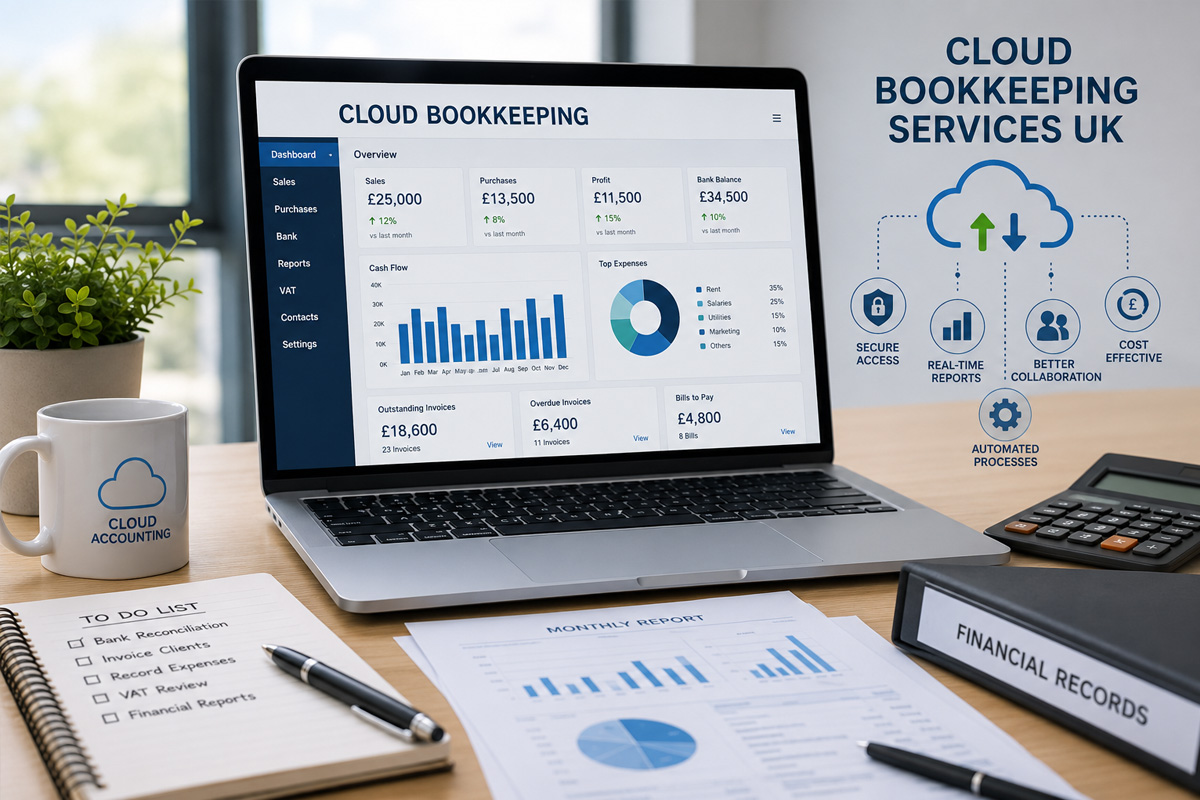
Cloud Bookkeeping Services UK are changing the way businesses manage their financial records. Instead of relying entirely on paper documents, spreadsheets, or accounting systems stored on individual computers, businesses can use cloud-based accounting platforms to record, organise, and access financial information online.
For growing UK businesses, bookkeeping can quickly become a time-consuming responsibility. Sales invoices, purchase invoices, expenses, bank transactions, supplier payments, customer receipts, and VAT-related records all need to be maintained accurately. Cloud bookkeeping can make these processes more accessible and organised while allowing authorised users and accounting professionals to work with financial information remotely.
This guide explains what Cloud Bookkeeping Services UK are, how cloud bookkeeping works, its benefits, the role of accounting software, common challenges, and what businesses should consider before choosing a cloud bookkeeping provider.
As a business grows, financial responsibilities often become more complicated. More transactions, employees, suppliers, customers, tax obligations, and reporting requirements can make accounting difficult to manage internally. Instead of handling every financial task themselves, many UK businesses choose to work with external accounting professionals.
However, outsourcing accounting is not simply about reducing costs. The right approach can also improve financial organisation, provide better reporting, support business decisions, and give management more time to focus on growth.
This guide explains what Outsourced Accounting Services UK involve, why businesses use them, what services can be outsourced, and what to consider before choosing an accounting partner.
What Are Cloud Bookkeeping Services UK?
Cloud Bookkeeping Services UK involve managing a business’s bookkeeping using cloud-based accounting software and online financial systems.
Unlike traditional bookkeeping systems where financial information may be stored locally, cloud accounting platforms allow authorised users to access financial records through an internet connection.
Depending on the business and service provider, cloud bookkeeping can include:
- Recording sales transactions
- Recording purchase transactions
- Expense management
- Bank reconciliation
- Invoice processing
- Accounts payable
- Accounts receivable
- VAT record management
- Financial reporting
- Monthly bookkeeping
- Cash flow monitoring
- Management reporting
The exact services depend on the business’s requirements and the accounting software being used.
How Does Cloud Bookkeeping Work?
Cloud bookkeeping combines accounting software with professional bookkeeping processes.
A typical process may work as follows:
1. Business Transactions Are Recorded
Sales, purchases, expenses, payments, and receipts are entered into the accounting system.
Some transactions can be imported automatically through connected bank feeds or integrated systems.
2. Transactions Are Categorised
Transactions need to be assigned to the appropriate accounting categories.
Correct categorisation is important because it affects financial reports, VAT information, and the overall accuracy of the accounts.
3. Bank Accounts Are Reconciled
The bookkeeping system can be compared with bank statements to identify missing, duplicate, or incorrect transactions.
4. Invoices and Expenses Are Managed
Sales invoices, supplier bills, receipts, and business expenses can be recorded and organised digitally.
5. Financial Reports Are Generated
Once transactions are recorded and reviewed, the system can generate reports such as profit and loss, balance sheet, cash flow, and outstanding invoice reports.
Why Are Cloud Bookkeeping Services Becoming Popular in the UK?
Businesses increasingly operate across different locations, and accounting teams may not always work from the same office.
Cloud bookkeeping makes financial information accessible to authorised users from different locations.
This can be useful for:
- Remote businesses
- Growing companies
- Multi-location organisations
- Small businesses
- Startups
- SMEs
- Accounting firms
- Businesses working with outsourced finance teams
Cloud systems can also reduce the need to exchange paper documents and manually transfer files between different people.
10 Benefits of Cloud Bookkeeping Services UK
1. Access Financial Information Remotely
One of the biggest advantages of cloud bookkeeping is accessibility.
Business owners and authorised finance professionals can access financial records from different locations, provided they have the appropriate login permissions and internet access.
This can be particularly useful for businesses with remote teams or external accountants.
2. Real-Time Financial Visibility
Traditional bookkeeping can sometimes involve delays between a transaction taking place and the records being updated.
Cloud-based systems can provide more current financial information when transactions and reconciliations are maintained regularly.
This can help management review revenue, expenses, outstanding invoices, and cash flow more frequently.
3. Easier Collaboration
Cloud accounting allows authorised users to work with the same financial data.
For example, a business owner, internal finance employee, and external accountant may be able to access the relevant accounting system without exchanging multiple versions of spreadsheets.
4. Reduced Paperwork
Digital bookkeeping reduces dependence on physical invoices, receipts, and financial documents.
Businesses can store and manage many financial records digitally, making information easier to organise and retrieve.
5. Automated Bank Feeds
Many cloud accounting platforms can connect with business bank accounts.
Transactions can then be imported into the accounting system, reducing some manual data entry.
However, imported transactions still need to be reviewed and categorised correctly.
6. Faster Bank Reconciliation
Cloud bookkeeping software can help match recorded transactions with bank transactions.
Regular reconciliation can make it easier to identify discrepancies and maintain accurate financial records.
7. Better Financial Reporting
Cloud accounting systems can generate financial reports using the information stored in the platform.
Businesses may be able to review:
- Profit and loss
- Balance sheet
- Cash flow
- Sales
- Expenses
- Customer balances
- Supplier balances
These reports can support regular financial reviews.
8. Supports Business Growth
As a business grows, the number of financial transactions usually increases.
Cloud systems can provide a scalable way to manage growing volumes of financial information without relying entirely on spreadsheets.
9. Integration With Other Systems
Many cloud accounting platforms can integrate with other business tools.
Depending on the software, integrations may be available for:
- Payroll
- Payment platforms
- E-commerce systems
- Expense management
- CRM systems
- Banking
- Invoicing
Integrations can help reduce duplicate data entry.
10. Supports Remote Accounting
Cloud bookkeeping makes it easier for businesses to work with external accounting professionals.
An outsourced accounting team can access the relevant financial system remotely, subject to the appropriate permissions and security controls.
What Is Included in Cloud Bookkeeping Services?
The scope of Cloud Bookkeeping Services UK varies depending on the provider.
Bookkeeping
Daily, weekly, or monthly transactions can be recorded and categorised.
Bank Reconciliation
Bank transactions can be compared with accounting records to identify discrepancies.
Invoice Management
Sales invoices and supplier invoices can be recorded and monitored.
Expense Tracking
Business expenses can be categorised and recorded for financial reporting.
Accounts Receivable
Customer invoices and outstanding balances can be monitored.
Accounts Payable
Supplier invoices and payment obligations can be managed.
VAT Support
Cloud bookkeeping can help maintain organised VAT-related transaction records and support VAT return preparation.
Financial Reporting
Businesses can receive regular financial reports based on their accounting data.
Popular Cloud Accounting Software in the UK
Different businesses use different accounting platforms depending on their needs.
Common cloud accounting software includes:
Xero
Xero provides cloud-based accounting features for businesses, including invoicing, bank reconciliation, reporting, and integrations.
QuickBooks
QuickBooks offers accounting and bookkeeping features designed for businesses of different sizes, including transaction management, invoicing, reporting, and banking tools.
Sage
Sage provides accounting and financial management software used by many businesses for bookkeeping, invoicing, reporting, and other accounting functions.
The best platform depends on the business’s requirements, budget, transaction volume, industry, and existing systems.
Is Cloud Bookkeeping Secure?
Security is an important consideration when financial information is stored online.
Businesses should look at the security features provided by their accounting software and bookkeeping provider.
Important considerations include:
- Strong passwords
- Multi-factor authentication
- User access permissions
- Secure data transmission
- Regular software updates
- Backup processes
- Controlled access to financial information
Businesses should also ensure that employees and external accounting providers only have access to the information they need.
Common Cloud Bookkeeping Mistakes
Although cloud software can automate many processes, mistakes can still happen.
Incorrect Transaction Categorisation
A transaction may be recorded under the wrong accounting category.
Not Reconciling Bank Accounts
Simply importing bank transactions does not mean the accounts are fully reconciled.
Duplicate Transactions
Transactions can sometimes be duplicated through manual entry or multiple integrations.
Ignoring Outstanding Invoices
Cloud systems can show unpaid invoices, but businesses still need an appropriate process for monitoring and following up on overdue balances.
Giving Too Much User Access
Businesses should carefully manage user permissions and only provide appropriate access to each person.
Relying Entirely on Automation
Automation can save time, but financial records still require human review.
Who Can Benefit From Cloud Bookkeeping Services UK?
Cloud bookkeeping can be suitable for many types of UK businesses, including:
- Startups
- Small businesses
- SMEs
- Limited companies
- E-commerce businesses
- Retail businesses
- Professional service firms
- Construction companies
- Hospitality businesses
- Technology companies
- Growing organisations
- Accounting firms
Businesses that already work remotely or use external accounting professionals may find cloud bookkeeping particularly useful.
How to Choose Cloud Bookkeeping Services UK
Choosing a cloud bookkeeping provider involves looking at both technology and professional expertise.
Check Accounting Experience
Choose a provider with experience managing bookkeeping for UK businesses.
Review Software Expertise
Check whether the provider works with platforms such as Xero, QuickBooks, or Sage if these are relevant to your business.
Understand the Service
Ask what is included in the monthly service.
For example, does it include bank reconciliation, invoice management, VAT support, and monthly reports?
Check Security Procedures
Understand how financial information and user access are managed.
Consider Communication
A clear communication process is important when an external team is managing financial records.
Look for Scalability
Your bookkeeping requirements may increase as your business grows. Choose a provider that can adapt to changing requirements.
How Cloud Bookkeeping Supports Business Decisions
Bookkeeping is not only about recording historical transactions.
When financial information is maintained regularly, businesses can use it to understand current performance.
For example, monthly reports can help management identify:
- Increasing expenses
- Changes in revenue
- Outstanding customer payments
- Supplier commitments
- Cash flow trends
- Profitability changes
This information can help business owners make more informed decisions about pricing, spending, hiring, investment, and growth.
Final Thoughts
Cloud technology has changed the way businesses manage their financial information. Instead of relying entirely on paper records, spreadsheets, or locally stored accounting systems, businesses can use online platforms to manage bookkeeping more efficiently.
Cloud Bookkeeping Services UK can help businesses maintain organised financial records, improve access to financial information, support collaboration, and reduce some of the administrative work involved in bookkeeping.
However, technology alone is not enough. Accurate bookkeeping still depends on appropriate processes, regular reconciliation, correct transaction categorisation, and professional review where required.
For businesses considering cloud bookkeeping, the best approach is to choose a suitable accounting platform, establish clear financial processes, manage user access carefully, and work with experienced bookkeeping professionals when additional support is required.
Know More About Finex Accounting
If your business is looking for professional Cloud Bookkeeping Services UK, Finex Accounting provides outsourced bookkeeping and accounting support for UK businesses and accounting firms. Its accounting support can help businesses manage bookkeeping, financial records, VAT-related processes, accounts receivable, accounts payable, and wider finance requirements.
Know More: Stay updated with the latest accounting insights, outsourcing tips, and industry trends by following Finex Accounting on LinkedIn and Instagram. Connect with us for practical advice, business updates, and expert financial guidance.